Friday, July 25, 2008

Herman Melville


Misgivings

When ocean-clouds over inland hills
Sweep storming in late autumn brown,
And horror the sodden valley fills,
And the spire falls crashing in the town,
I muse upon my country's ills--
The tempest burning from the waste of Time
On the world's fairest hope linked with man's foulest crime.

Nature's dark side is heeded now--
(Ah! optimist-cheer disheartened flown)--
A child may read the moody brow
Of yon black mountain lone.
With shouts the torrents down the gorges go,
And storms are formed behind the storms we feel:
The hemlock shakes in the rafter, the oak in the driving keel.


Excerpts from The Lightning-Rod Man
What grand irregular thunder, thought I, standing on my hearthstone among the Acroceraunian hills, as the scattered bolts boomed overhead and crashed down among the valleys, every bolt followed by zigzag irradiations, and swift slants of sharp rain, which audibly rang, like a charge of spear-points, on my low shingled roof. I suppose, though, that the mountains hereabouts break and churn up the thunder, so that it is far more glorious here than on the plain. Hark! -- some one at the door. Who is this that chooses a time of thunder for making calls? And why don't he, man-fashion, use the knocker, instead of making that doleful undertaker's clatter with his fist against the hollow panel? But let him in. Ah, here he comes. "Good day, sir:" an entire stranger. "Pray be seated." What is that strange-looking walking-stick he carries: "A fine thunder-storm, sir."

"Fine? -- Awful!"

"You are wet. Stand here on the hearth before the fire."

"Not for worlds."

The stranger still stood in the exact middle of the cottage, where he had first planted himself. His singularity impelled a closer scrutiny. A lean, gloomy figure. Hair dark and lank, mattedly streaked over his brow. His sunken pitfalls of eyes were ringed by indigo halos, and played with an innocuous sort of lightning: the gleam without the bolt. The whole man was dripping. He stood in a puddle on the bare oak floor: his strange-walking stick vertically resting at his side.

It was a polished copper rod, four feet long, lengthwise attached to a neat wooden staff, by insertion into two balls of greenish glass, ringed with copper bands. The metal rod terminated at the top tripodwise, in three keen tines, brightly gilt. He held the thing by the wooden part alone.

"Sir," said I, bowing politely, "have I the honor of a visit from that illustrious God, Jupiter Tonans? So stood he in the Greek statue of old, grasping the lightning-bolt. If you be he, or his viceroy, I have to thank you for this noble storm you have brewed among our mountains. Listen: that was a glorious peal. Ah, to a lover of the majestic, it is a good thing to have the Thunderer himself in one's cottage. The thunder grows finer for that. But pray be seated. This old rush- bottomed arm-chair, I grant, is a poor substitute for your evergreen throne on Olympus; but, condescend to be seated."

While I thus pleasantly spoke, the stranger eyed me, half in wonder, and half in a strange sort of horror; but did not move a foot.

* * * * *

"My special business is to travel the country for orders for lightning-rods. This is my specimen rod;" tapping his staff; "I have the best of references" -- fumbling in his pockets. "In Criggan last month, I put up three-and-twenty rods on only five buildings."

"Let me see. Was it not at Criggan last week, about midnight on Saturday, that the steeple, the big elm, and the assembly-room cupola were struck? Any of your rods there?"

"Not on the tree and cupola, but on the steeple."

"Of what use is your rod, then?"

"Of life-and-death use. But my workman was heedless. In fitting the rod at top to the steeple, he allowed a part of the metal to graze the tin sheeting. Hence the accident. Not my fault, but his. Hark!"

"Never mind. That clap burst quite loud enough to be heard without finger-pointing. Did you hear of the event at Montreal last year? A servant-girl struck at her bedside with a rosary in her hand; the beads being metal. Does your beat extend into the Canadas?"

"No. And I hear that there, iron rods only are in use. They should have mine, which are copper. Iron is easily fused.

* * * * *

"You pretended envoy extraordinary and minister plenipotentiary to and from Jupiter Tonans," laughed I; "you mere man who come here to put you and your pipestem between clay and sky, do you think that because you can strike a bit of green light from the Leyden jar, that you can thoroughly avert the supernal bolt? Your rod rusts, or breaks, and where are you? Who has empowered you, you Tetzel, to peddle round your indulgences from divine ordinations? The hairs of our heads are numbered, and the days of our lives. In thunder as in sunshine, I stand at ease in the hands of my God. False negotiator, away! See, the scroll of the storm is rolled back; the house is unharmed; and in the blue heavens I read in the rainbow, that the Deity will not, of purpose, make war on man's earth."

"Impious wretch!" foamed the stranger, blackening in the face as the rainbow beamed. "I will publish your infidel notions."

"Begone! move quickly! if quickly you can, you that shine forth into sight in moist times like the worm."

The scowl grew blacker on his face; the indigo-circles enlarged round his eyes as the storm rings round the midnight moon. He sprang upon me; his tri-forked thing at my heart.

I seized it; I snapped it; I dashed it; I trod it; and dragging the dark lightning-king out of my door, flung his elbowed, copper sceptre after him.

But spite of my treatment, and spite of my dissuasive talk of him to my neighbors, the Lightning-rod man still dwells in the land; still travels in storm-time, and drives a brave trade with the fears of man.

Thursday, July 24, 2008

Taoism - Growth of a Religion by Isabelle Robinet


The "Chuci", the Wu, and the Fangshi, pages 35-41.

“The Future” by Wesley McNair


On the afternoon talk shows of America
the guests have suffered life's sorrows
long enough. All they require now
is the opportunity for closure,
to put the whole thing behind them
and get on with their lives. That their lives,
in fact, are getting on with them even
as they announce their requirement
is written on the faces of the younger ones
wrinkling their brows, and the skin
of their elders collecting just under their
set chins. It's not easy to escape the past,
but who wouldn't want to live in a future
where the worst has already happened
and Americans can finally relax after daring
to demand a different way? For the rest of us,
the future, barring variations, turns out
to be not so different from the present
where we have always lived - the same
struggle of wishes and losses, and hope,
that old lieutenant, picking us up
every so often to dust us off and adjust
our helmets. Adjustment, for that matter,
may be the one lesson hope has to give,
serving us best when we begin to find
what we didn't know we wanted in what
the future brings. Nobody would have asked
for the ice storm that takes down trees
and knocks the power out, leaving nothing
but two buckets of snow melting
on the wood stove and candlelight so weak,
the old man sitting at the kitchen table
can hardly see to play cards. Yet how else
but by the old woman's laughter
when he mistakes a jack for a queen
would he look at her face in the half-light as if
for the first time while the kitchen around them
and the very cards he holds in his hands
disappear? In the deep moment of his looking
and her looking back, there is no future,
only right now, all, anyway, each one of us
has ever had, and all the two of them,
sitting together in the dark among the cracked
notes of the snow thawing beside them
on the stove, right now will ever need.

"Another country where things are in order"


There was a great drought where Wilhelm lived; for months there had not been a drop of rain and the situation became catastrophic. The Catholics made processions, the Protestants made prayers, and the Chinese burned joss-sticks and shot off guns to frighten away the demons of the drought, but with no result.

Finally the Chinese said, ‘We will fetch the rain-maker.’ And from another province a dried up old man appeared. The only thing he asked for was a quiet little house somewhere, and there he locked himself in for three days.

On the fourth day the clouds gathered and there was a great snow-storm at the time of the year when no snow was expected, an unusual amount, and the town was so full of rumours about the wonderful rain-maker that Wilhelm went to ask the man how he did it.

In true European fashion he said: ‘They call you the rain-maker; will you tell me how you made the snow?’

And the little Chinese said: ‘I did not make the snow; I am not responsible.’

‘But what have you done these three days?’

‘Oh, I can explain that. I come from another country where things are in order. Here they are out of order; they are not as they should be by the ordinance of heaven. Therefore the whole country is not in Tao, and I also am not in the natural order of things because I am in a disordered country. So I had to wait three days until I was back in Tao and then naturally the rain came.’”
Mysterium Conjunctionis, by Carl Jung

Schweppes Commercial

Wednesday, July 23, 2008

Tewkesbury, UK - July 23, 2008


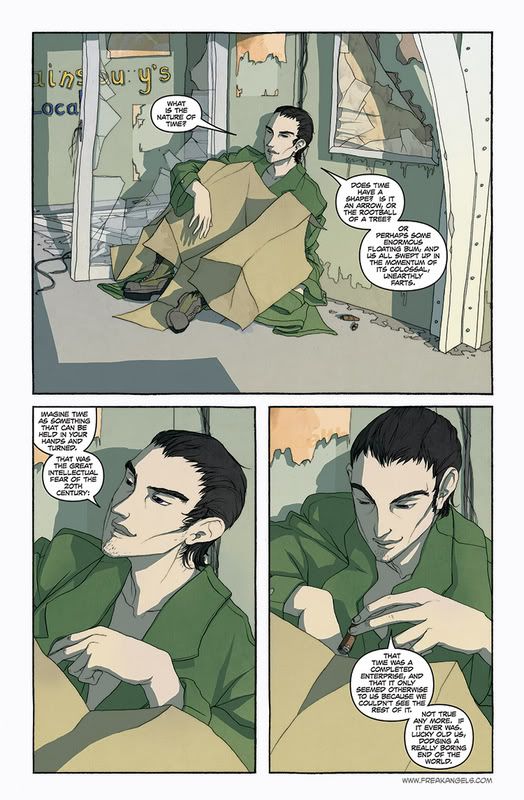
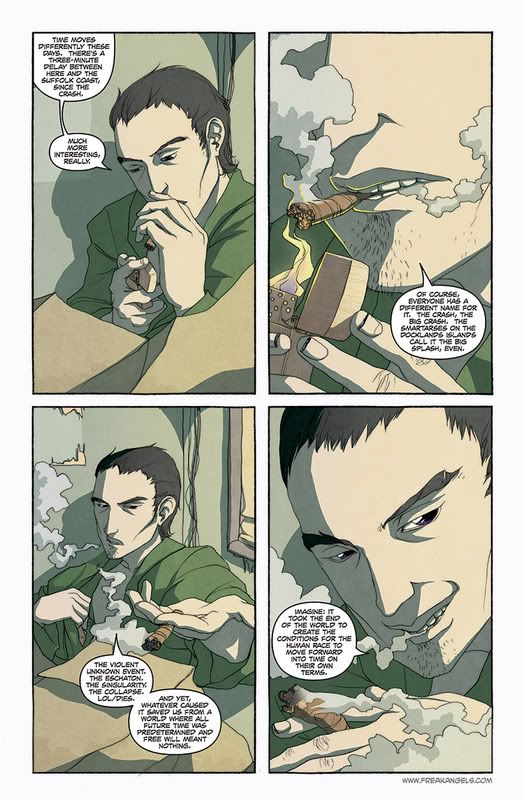
...And for good measure, check out the webcomic "Freakangels" by Warren Ellis, about some very curious individuals in England who survived a catastrophic worldwide flood.

Note especially the monologue in Episode 4 describing the nature of time after the apocalypse. (Click on Thumbnails to view.)


Buddhism and Science

The Venerable Hsuan Hua, a Ch'an and Tripitika master from China, arrived in America in the early 1960s to propagate the Dharma in the West. As he observed and studied the trends and currents of contemporary thought, he showed little enthusiasm for what seemed to him the exaggerated claims of modern science—theoretical or applied. He said, “Within the limited world of the relative, that is where science is. It’s not an absolute Dharma. Science absolutely cannot bring true and ultimate happiness to people, neither spiritually nor materially.” This is strong criticism that portrays science as a discipline limited to relative truths, and as an unsatisfactory way of life. In another essay, he wrote:

Look at modern science. Military weapons are modernized every day and are more and more novel every month. Although we call this progress, it’s nothing more than progressive cruelty. Science takes human life as an experiment, as child’s play, as it fulfills its desires through force and oppression.

In 1989, Venerable Walpola Rahula, a Theravadin monk from Sri Lanka, also warned that daily life is being permeated by science. He cautioned, “We have almost become slaves of science and technology; soon we shall be worshipping it.” His comments come well into the final decades of the twentieth century, when many people had in effect turned science into a religious surrogate. The Venerable monk observed, “Early symptoms are that they tend to seek support from science to prove the validity of our religions.” Walpola Rahula elaborated on this point:

We justify them [i.e. religions] and make them modern, up-to-date, respectable, and accessible. Although this is somewhat well intentioned, it is ill-advised. While there are some similarities and parallel truths, such as the nature of the atom, the relativity of time and space, or the quantum view of the interdependent, interrelated whole, all these things were developed by insight and purified by meditation.
From Buddhism and Science: Probing the Boundaries of Faith and Reason by Dr. Martin J. Verhoeven

Religion East and West, Issue 1, June 2001, pp. 77-97